

Colour / Research draft
Source colour and display treatments
The colour study proposes retaining network colour definitions and recording derived display treatments separately. Its calculations examine declared digital conditions; passenger performance and physical media require further evidence.
Selected findings
Roles within a network
Colour can identify a network, mode, service family or current state. The documentary cases keep these roles distinct.
Different measures
Paint/background contrast, distance between modelled colours and a passenger's ability to trace a route answer different questions.
Screen and physical media
Screen values do not establish print matching or physical sign performance. Colour-vision transforms approximate selected conditions rather than measuring individual vision.
From evidence to design
OTI proposals
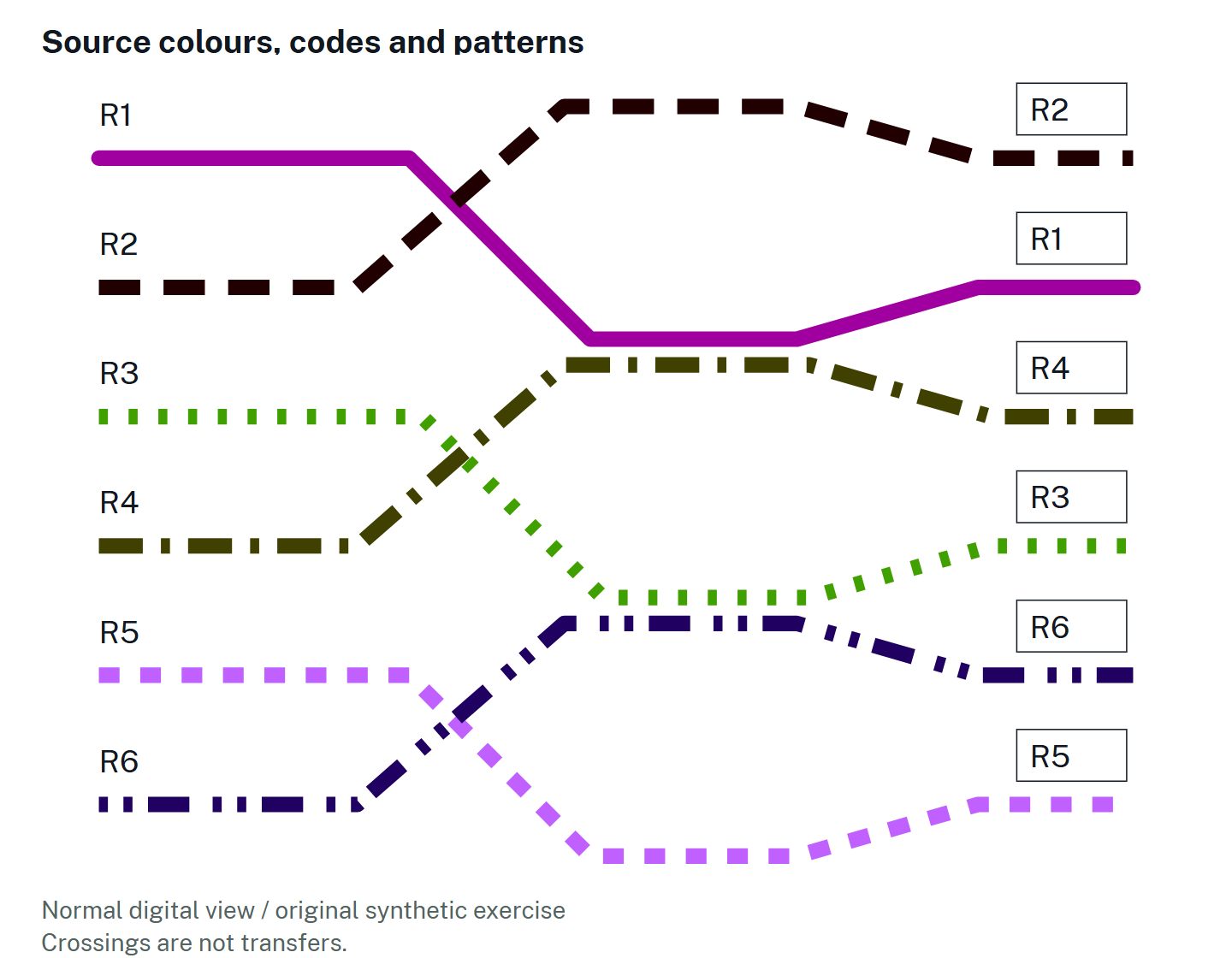
Source and derived treatment
Keep the original colour definition, authority, version and role separate from its display adaptation.
Non-colour information
Include names, repeated codes and explicit state wording. Test boundaries, backplates or patterns for the intended context.
Task errors and clutter
Use the evaluator to identify numerical conflicts, then test whether proposed display support reduces task errors enough to justify its additional clutter.